The challenge
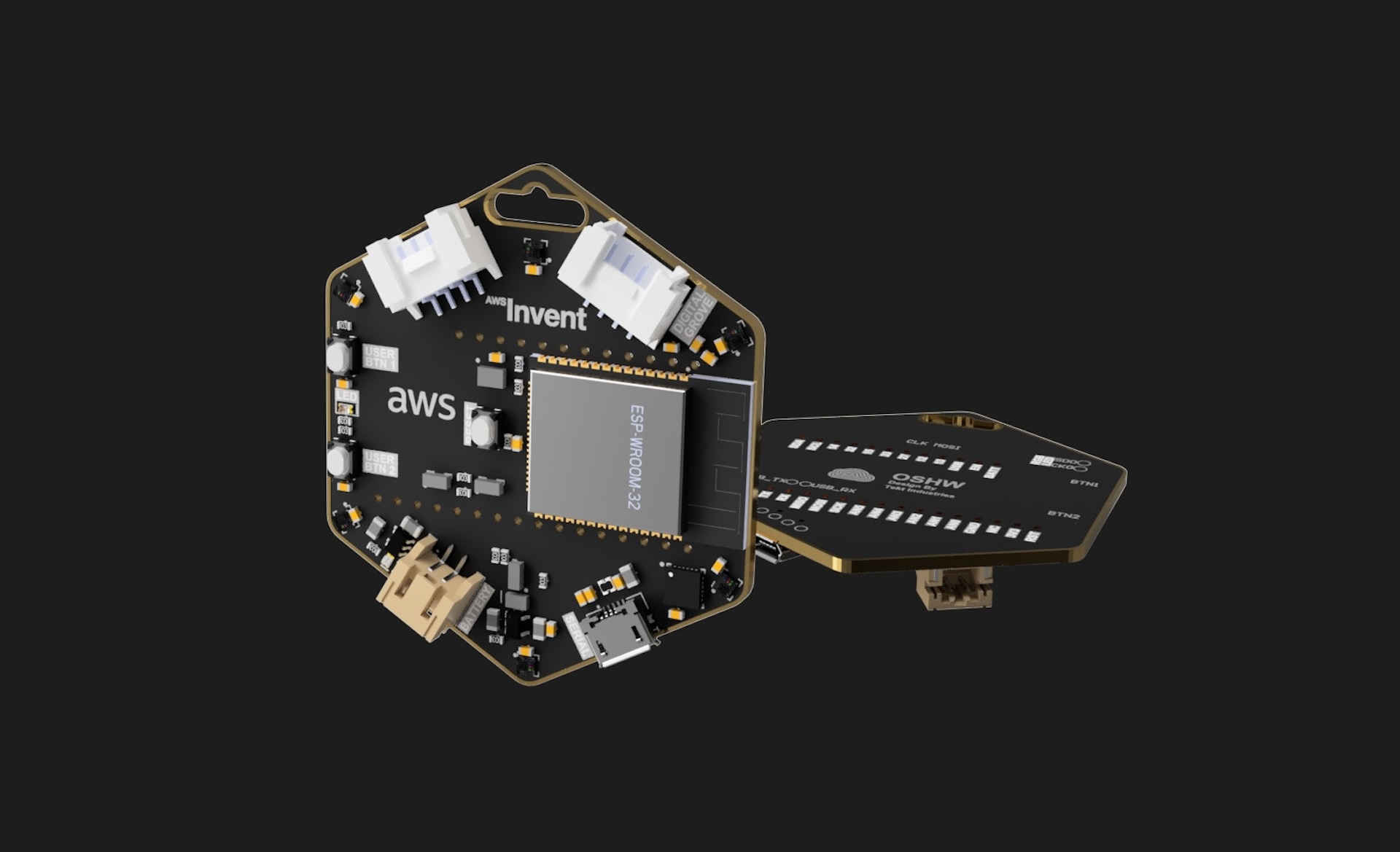
AWS commissioned a wearable lanyard for re:Invent, its global conference in the United States, to be handed to attendees at the AWS IoT workshops and guided sessions. It had to be a real device rather than a souvenir — something an attendee could take out of the box, connect to a network, have talking to AWS IoT quickly, and keep experimenting with afterwards.
The work
The board
What we designed is a bare hexagonal PCB with a lanyard slot cut into the outline — no enclosure. On it: an Espressif ESP-WROOM-32 module, a Microchip ECC508 cryptographic coprocessor, a micro-USB serial port, a JST battery connector, two user buttons, a reset, user LEDs, and Grove headers for analog and digital sensors. The reverse carries an OSHW open-source-hardware mark beside the line "Design By Tekt Industries". The board supports both Mongoose OS and Amazon RTOS, Wi-Fi carries the sensor and control messaging, and edge data collection was the other intended use. The workshop exercises drove LEDs and basic IO on the board itself.
The reference code
Tekt designed it with AWS, and shipped it with reference code developed jointly with AWS so that first connection worked without a fight. This was early in the adoption cycle for connected products, and for a lot of the makers and software engineers in the room it was their first time putting a device on Wi-Fi and talking to a cloud service.
Manufacture and the calendar
Tekt did the hardware and PCB design and manufactured the units. The constraint was the calendar: eight to ten weeks for the full design cycle, a single round with no second iteration, and a thousand units shipped to the United States ahead of the event. There was no version of this where the date moved.
After re:Invent
For years afterwards the device remained referenced in the AWS IoT Core getting-started documentation. The platform had a second life at home, too: Tekt used it for Super Hack, a program run with the University of Melbourne and a group of local high schools to get young women into software development.
About the client
The relationship came through an introduction from Intel, to Anton Shmagin at AWS, and it did not start with the lanyard. Tekt had presented a custom IoT system on stage at the AWS Summit in Sydney in April 2016, at the global launch of AWS IoT Core, to a room of around eight hundred people. The lanyard followed the next year, delivered in September 2017 for re:Invent. By August 2017, three months out, Tekt was already describing itself publicly as "an existing partner to Amazon Web Services".