
Consumer
Evolve MVMT

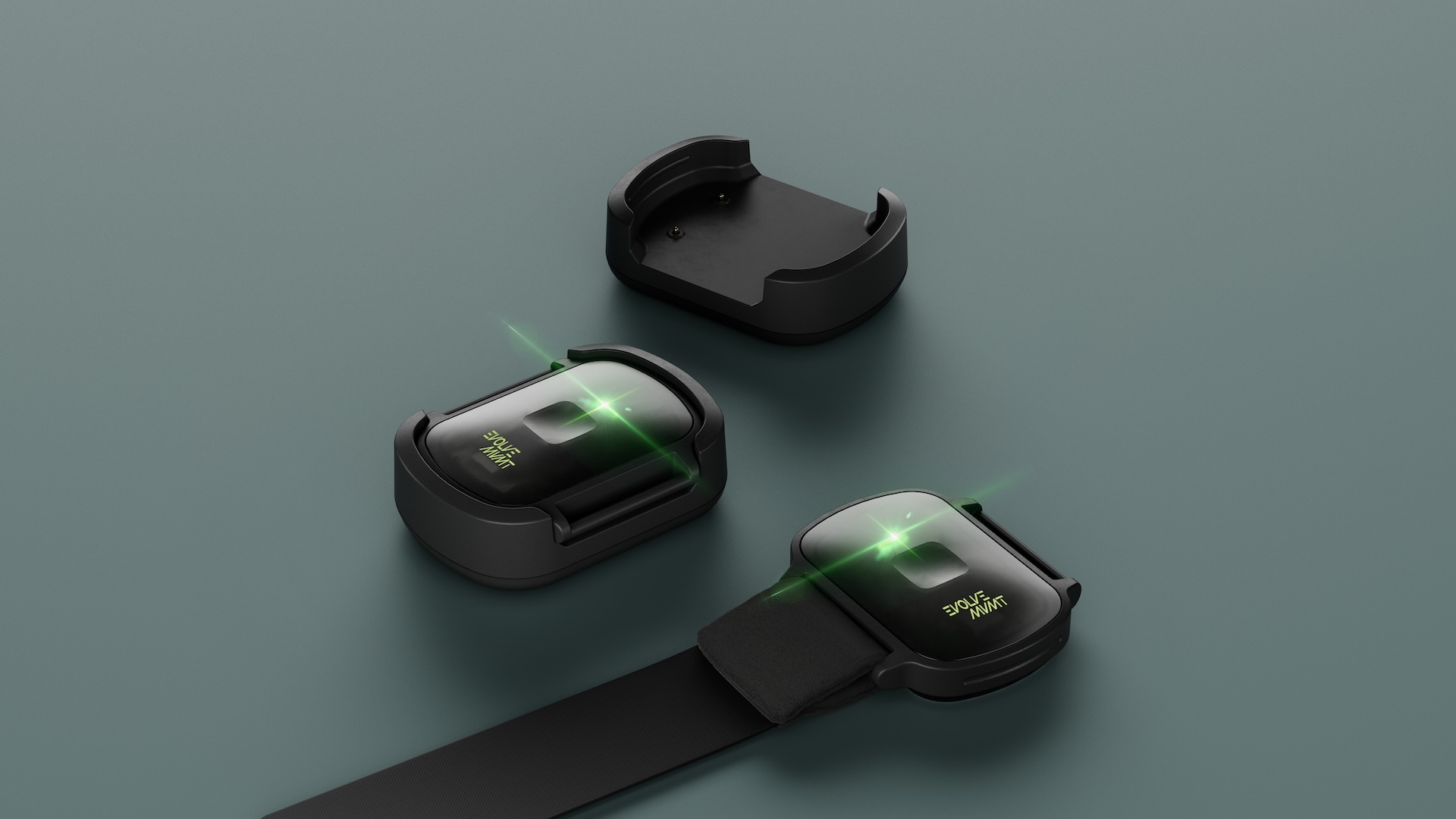
EVOLVE MVMT is an ankle-worn sensor that scores how well a walker or runner absorbs the shock of each step, and coaches the technique that improves it — live, through a vibration at the ankle and a step-by-step display in a companion app. The measurement is the invention of a sports physiotherapist; the hardware, firmware, apps, clinical portals and cloud that turn it into a product have been built at Tekt since 2018.
The challenge
Every footstrike sends force up through the ankle, shin, knee, hip and spine, and EVOLVE MVMT's account of the problem is that when the muscles are not working optimally more of that force is transferred into the joints, "leading to wear and tear on your body and injury". What the company measures is force transmission beneath the skin — data, in its words, that "cannot be reliably identified through" visual observation, video analysis or traditional gait assessment. That is why, EVOLVE says, the technology "was originally developed for clinical use", and its pitch for the consumer product is that access to the measurement had until now belonged to elite teams and leading clinical institutions.
Bringing that measurement out of the clinic set the engineering problem. The result had to be small enough to strap to the inside of an ankle and be worn for a full walk or run. It had to score every step as it happened rather than in a report afterwards. It had to coach the wearer without them watching a screen. And it had to keep working when there was no phone in the picture at all.
The work
The measurement is the client's invention and the proprietary algorithm that produces it is the client's IP. Everything that captures, processes, delivers and — later — manufactures it has been built at Tekt since 2018: the impact-measurement hardware, the embedded firmware, the Bluetooth systems, the two apps and their Apple Watch companions, the clinical portals, and the cloud services behind them.
The product runs as two strands off that one platform. One targets pre-operative diagnostics and the post-operative market, with the hardware, app and clinical portals supporting a medical-class device. The other is the consumer solution, delivered across two generations of software.
The sensor
Underneath the score is high-speed IMU acquisition: the sensor captures motion and force telemetry at high rate, records it to the device, and streams it to a phone for real-time feedback on force transmission through the joints.
The sensor sits on the inside of the ankle, where — as EVOLVE describes it — it "can detect the movement of your bone and with the help of algorithms determine the performance of your shock absorption". That resolves to a step score out of ten to one decimal place, a biofeedback scale developed by the company's clinical team on which ten is optimal shock absorption and efficiency and five is average.
Scoring on the device is what makes coaching possible without a screen. When a step falls below the wearer's threshold, the unit vibrates and its LED flashes red. The same LED carries the rest of the device's state: green flashing for a live app-connected session, amber flashing when it is recording without the app, a slow flash for walking and a fast flash for running, solid for paused, two red flashes for low battery, flashing blue while charging and solid blue when charged. One button — a central depression in the housing — powers the device up and down on a press and hold, and the device shuts itself down after five minutes of inactivity when it is not paired to the app, to conserve battery. It charges on a base that runs off any standard USB charger. The sensor is splash-proof rather than waterproof; the strap is machine washable.
Bluetooth Low Energy
The sensor "sends the data wirelessly to your chosen smart device via Bluetooth" — Bluetooth 4.0 Low Energy at 2.4 GHz, with a typical range EVOLVE gives as "approximately 40 feet (12 metres) with no solid objects in between", and with normal body movement already accounted for in the algorithm. Pairing is deliberately physical: the app asks which leg the unit is going on, the wearer shakes it to identify it, and the app answers with that device's ID and battery level. A wearer can run one sensor and swap legs between weeks, or one on each leg.
The apps
There are two, and Tekt built both: the consumer Evolve MVMT app and Evolve MVMT Clinical, each published on the App Store by Tekt Industries Pty Ltd. Clinical shipped first, in February 2025, with the consumer app following in December. Both run on iOS 15.6 or later, both carry an Apple Watch companion, and Android builds ship alongside them. Clinical also runs on iPad and on Apple silicon Macs, which is how a practice actually uses it.
The consumer app is the wearer's own. It carries profile setup and the pairing flow, and collects the session settings the scoring depends on — walk or run, shoe type, surface. It runs the barefoot baseline that establishes a wearer's natural technique, then generates the personalised thresholds every later session is judged against. During a live session each step draws a circle: small and high on the screen for a good step, large and low for a poor one, against the dotted threshold line. Apple describes it as a gateway to a better gait, tracking walk performance with in-app guidance.
Clinical turns the same data into something a practitioner can work from — the listing puts it as helping a patient and their physician track impact data, completing walk sessions and improving a score. The device, the thresholds and the scoring are shared; what differs is who is reading the result and on what screen.
The disconnected case is the more interesting one. A session can be started in Free mode, where the sensors record on their own and keep giving vibration feedback with the phone put away. Afterwards the app prompts the wearer to offload that session, and works out for itself which unit was on which leg if the pair has been mixed up. Post-session analysis is the other half of the product: a summary of steps, time and thresholds, sessions labelled so they can be compared later, left leg against right, one surface against another, and progress tracked over time.
The clinical portals and the cloud
The clinical strand needs more than an app on a practitioner's iPad. Sessions have to arrive somewhere a clinic can work from, be attached to the right patient and the right leg, and stay comparable across appointments — so Tekt built the clinical portals and runs the cloud services behind both strands. A session can also be started on the device or on the Apple Watch with no connectivity at all and upload when the connection returns, which is what makes the product usable in a gym, on a court or on a road.
Manufacture and launch
Tekt manufactured as well as designed. The hardware and firmware were developed here, and then more than a thousand devices were fabricated in house, fully packaged as a turnkey service and delivered to the client's distribution centres globally.
EVOLVE MVMT launched Version 1, "Light Walking", at CES in 2024. A second version aimed at running is announced on the company's site as coming, positioned there as "the world's first wearable to analyze shock absorption and running efficiency"; on the engineering side, the second generation of the consumer software has been in test build through 2026, iOS and watchOS together. The consumer release ran a successful international campaign, and commercialisation continues into specialist sport — professional basketball in the US among others, where joint impact loads during and after training are high and where sports physiotherapists and sports scientists want the best instrumentation they can get to improve an athlete's motion profile, heal them faster and keep them out of injury.
About the client
Evolve MVMT Pty Ltd was founded by Luke Pickett, a sports physiotherapist who invented the measurement at the centre of the product and has driven the work since 2018. Eight years on, the programme is still running.
EVOLVE MVMT sells its ankle wearable to runners and walkers, and to the coaches and clinicians who work with them. Light walking is the company's own concept — placing the heel lightly so that, as it explains, the muscles are primed to absorb force more readily and muscle activity is increased. The step score behind it was developed by EVOLVE's clinical team, and the company's patents page lists United States Patent 8,581,731 along with a number of patents pending.
Ready to reach out?
If you have an electronic product idea but lack the knowledge, time or resources to make it happen, we can help.
↑ Back to top