
R & D
Telstra IoT Dev Kit

Telstra's first Cat-M1 and NB-IoT developer kits were built while Telstra was still standing up the networks — and the work found non-compliant micro cell towers in the process. Two generations, 110 units then 250, to Telstra enterprise partners and to muru-D.
The challenge
From 2016 to 2018 Tekt worked with Telstra's CTO group and Quectel to build the first Cat-M1, then NB-IoT, development hardware with integrated GPS. There were very few reference designs at the time and almost nothing available with the new radio technology.
The kits also had a job to do. Telstra's Innovation Challenge sets university, enterprise and public teams one problem to solve with IoT, and entrants can only build as far as the hardware they are handed. Whatever went out had to work first time, in the hands of people for whom this was often a first connected device.
The work
Building against a network that did not exist yet
Because the work ran concurrently with Telstra standing up the networks, development doubled as field validation. Tekt detected that micro cell towers were not fully compliant with the standard — the software updates had not yet rolled out to them. That finding came out of building against a network that did not quite exist yet. Modules from u-blox, Telit and Quectel were being evaluated in hardware from September 2017 to stay ahead of the same problem.
A secure connection in a handful of lines
The firmware went well beyond integrating the Quectel module. Tekt implemented a cryptographic coprocessor using the Microchip ATECC508, with wolfSSL providing TLS and X.509 certificate-based handshaking, first to Cumulocity — Telstra's own cloud partner — and later to AWS IoT. The point of the coprocessor firmware was to collapse a complex certificate exchange into a few lines of user code. The same coprocessor firmware also carried communications, socket management, LWM2M services and payload transmission, which kept all of it out of the entrant's own code.
Two generations
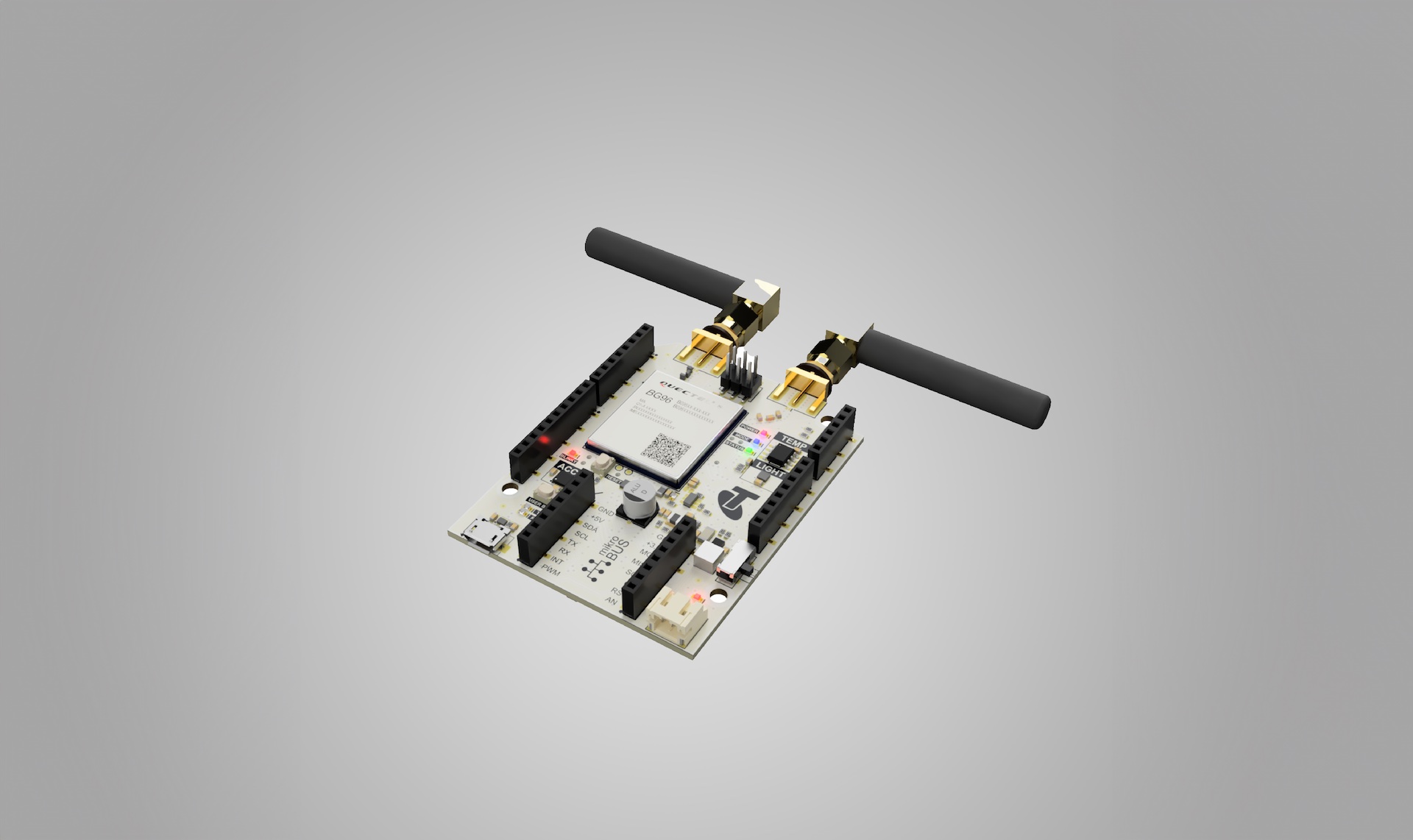
Generation one was an Arduino-form shield that connected Intel's Genuino 101 to the Telstra network. Generation two moved to a Quectel BG96 for Cat-M1 and NB-IoT and integrated the Arduino onto a single board, delivered as a university and a public variant, with GPS, temperature, ambient light and accelerometer sensing, a MikroBUS breakout and battery supply sub-systems. An Arduino sketch could open a secure IoT connection in a handful of lines. The boards were designed, assembled and tested in Melbourne, and the software APIs were delivered with them; Telstra published the kit's setup guide on GitHub.
110 units, then 250, went to Telstra enterprise partners and to muru-D, Telstra's startup incubator.
The outcome
Telstra never commercialised the kits further. The value was strategic: it secured their position as a market leader as the standards were ratified and rolled out globally, and it accelerated their partners' own commercialisation. Telstra called the first-generation kit "a key enabler for the future of IoT connectivity"; the 2017 Innovation Challenge winners — DiUS, Team CQU and Farmate — built a fertiliser tank, a fertigation controller and a hive monitor on it.
About the client
The client was Telstra's CTO group, working with Quectel on the radio side, Cumulocity as its cloud partner and muru-D as the route to startups building on the new networks. The relationship ran across two generations of hardware and both new radio standards, at the point where neither the networks nor the standards had finished arriving.
Ready to reach out?
If you have an electronic product idea but lack the knowledge, time or resources to make it happen, we can help.
↑ Back to top